How to Keep a Trolling Spread at the Right Depth When Boat Speed and Current Change
Changing speed or current can throw off your trolling spread. Learn how to adjust lure depth and more to keep your lures in the strike zone.
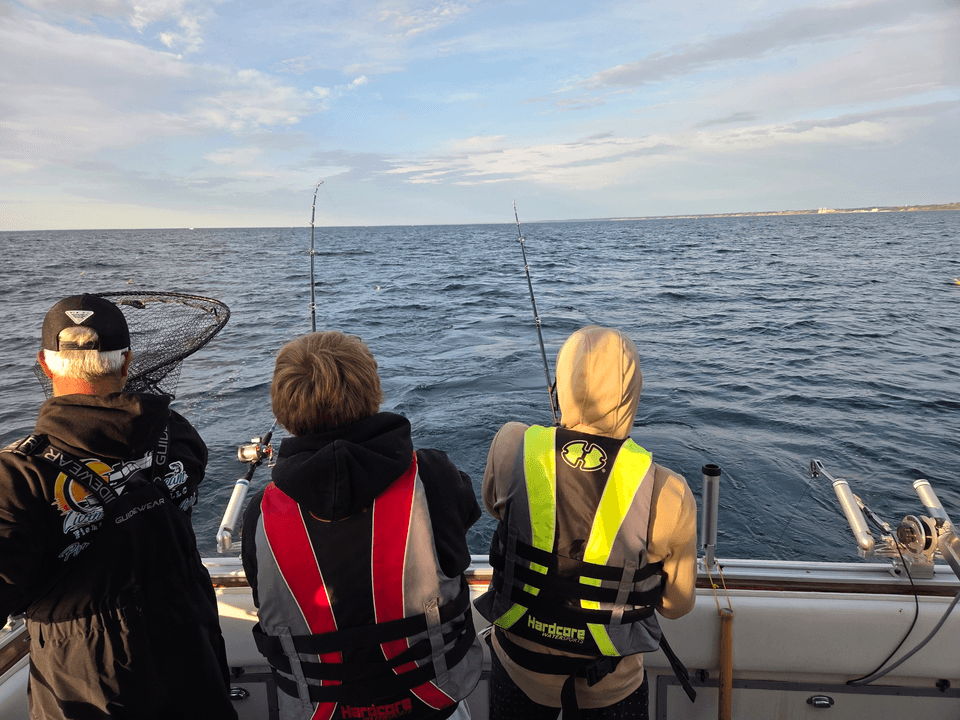


Keeping a trolling spread at the right depth seems easy until you speed up, the current flips, or you turn around, and your lures stop catching fish. A setup that ran perfectly on one pass can fish several feet higher or lower on the next, even though you haven't touched your rods, reels, or line lengths.
Line length alone doesn't set your trolling depth. Boat speed, current, lure resistance, line diameter, sinkers, diving devices, and your trolling direction all change where your baits actually run.
When you fish multiple lines at different depths, even small changes can throw off the whole spread. Your deep lure may climb out of the strike zone, your shallow bait may dig too aggressively, or two lines you separated vertically may end up fishing at nearly the same depth.
That's why we're here to help you figure out what's changing underwater, and how to make adjustments that put your spread back in position.
Why Your Trolling Depth Changes Even When You Don't Change Your Setup
Your lure's running depth comes down to a balance between the force pulling it forward and the resistance the water creates. That resistance changes with speed, and every lure, line, and trolling device responds differently.
Here's what could be throwing off your spread:
Boat speed: Trolling faster increases the water resistance against your lure, line, sinker, and diving device.
Current: Current moving with or against your boat changes your presentation's speed relative to the water
Line angle: More drag can pull your line farther behind the boat and reduce your presentation's vertical depth.
Lure design: Deep-diving plugs, spoons, flashers, and soft baits each respond differently to speed changes.
Turns: Your speed and direction relative to the current change throughout a turn. Lines on the inside of the turn slow down, while outside lines speed up.
Line length and diameter: Longer lines create more drag, and thicker lines generally meet more resistance, which can keep diving lures from reaching their intended depth.
That's why you need to monitor your spread throughout the trip, especially when fishing in strong currents, changing depths, or making frequent turns.
1. Understand the Difference Between GPS Speed and Speed Through Water
One of the biggest trolling mistakes is treating GPS speed as the only speed that matters.
Your GPS measures speed over ground (SOG), which tells you how quickly your boat moves relative to land. But your lure moves through water, and the water itself may be moving.
Your GPS may show 2.5 mph, but if the current is moving in the same direction, your speed through the water may be slower than you'd expect.
Turn around and troll against that current at the same GPS speed, and your lure may meet substantially more water resistance. That's why the same GPS speed can give you different lure actions and depths on opposite headings.
How to Adjust When Trolling With or Against Current
Instead of trying to maintain the same GPS speed in both directions, use your productive pass as a baseline.
If fish are biting while you're trolling in one direction:
Note your GPS speed, heading, and lure configuration.
Observe your rod-tip movement, diver angle, and downrigger cable angle.
Turn around and begin your return pass.
Adjust your throttle until the lures appear to have similar action and the lines load similarly.
Check whether the same depth is producing bites.
If you're equipped with a speed probe near your downrigger ball, you can measure speed at fishing depth. This is useful when surface current and deeper water movement don't match.
Your GPS may show 2.5 mph, but if the current is moving in the same direction, your speed through the water may be slower than you'd expect.
2. Recognize How Increased Speed Affects Lure Depth
When you speed up, water resistance on your line and lure increases. What happens next depends on your presentation.
Diving Plugs
A diving plug's bill or lip pulls it downward as you troll. Speeding up generally increases that diving action, but only until the lure stops swimming as intended.
Too much speed can make a plug wobble excessively, roll, or lose its natural swimming motion. It may also pull harder against your rod, which makes it hard to keep the same presentation across the spread.
If you need to speed up because of current or boat control, watch the rod tip. Watch for a lure that suddenly vibrates aggressively or pulls differently. It may no longer swim as intended.
Spoons and Flatlines
Spoons can rise or change action when you speed up, depending on their shape, weight, and rigging. Lightweight presentations react especially strongly to speed changes.
Longer setbacks also add drag, so a lure that runs correctly with 50 feet of line out may behave differently with 100 feet.
Weighted Lines
Line weight, line length, speed, and drag all affect lead-core, copper, inline weights, and other sinking presentations.
If you increase speed, the line may angle farther behind the boat. That added horizontal distance doesn't necessarily give you more depth.
With weighted lines, avoid changing speed and line length at the same time. Change one variable, watch what happens, then adjust again if you need to.
3. Account for Downrigger Blowback
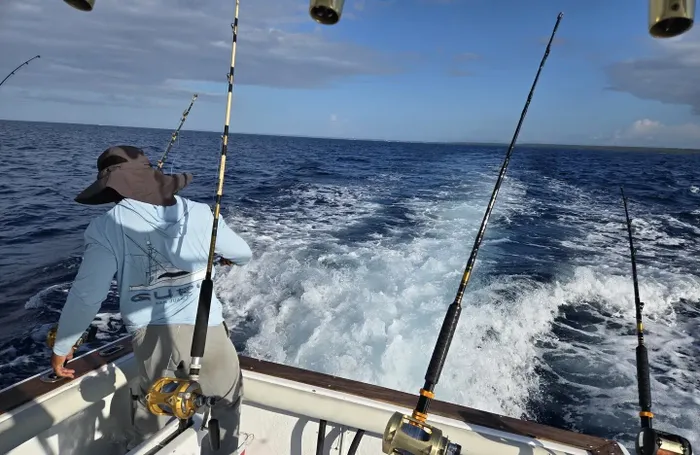
If you're using downriggers, one of the most important concepts to understand is blowback.
Blowback occurs when water resistance pushes your downrigger weight and cable backward as they're pulled through the water.
The faster you troll, the greater the horizontal angle generally becomes between the downrigger and the weight. As the cable angles farther back, the weight becomes shallower than the amount of cable you've released might suggest.
For example, releasing 100 feet of cable doesn't mean your downrigger ball is sitting 100 feet directly below the boat. At higher speeds, the cable angles backward, so part of its length extends horizontally behind the boat.
Cannon's downrigger guidance illustrates this: an 8-pound weight with 100 feet of cable out at 4 mph reaches about 80 feet of actual depth in no current. Current, water conditions, cable, and added equipment can change that result.
How to Reduce Blowback
If your downrigger weight is running shallower than you need, you have several options:
Slow down: Reducing speed decreases the drag pulling the weight backward.
Use a heavier weight: A heavier ball can resist the water's force and maintain a more vertical cable angle.
Release more cable: Additional cable can compensate for blowback, although the amount needed depends on conditions.
Check cable angle: A steeply angled cable is a visual warning that your weight may not be reaching the intended depth.
Use a downrigger probe: A probe that measures speed and temperature at the ball can provide a more accurate picture of what's happening at fishing depth.
Remember, increasing cable length won't always solve the problem. If your trolling speed or current has changed significantly, you may need to reevaluate the entire setup.
4. Adjust Your Spread When Current Changes
Current doesn't hit every line in your spread equally. A lure close to the boat may feel different water movement than a presentation farther back or deeper in the water column.
You'll notice this most when you fish multiple lines, especially a mix of downriggers, diving planers, flatlines, and weighted presentations.
When Trolling With the Current
When the current is moving in the same direction as your boat, you may need to increase your GPS speed to maintain the same lure speed through the water.
However, increasing your throttle can also increase drag on your lines and diving devices. A downrigger ball may experience more blowback, and diving plugs may pull harder or run differently.
If you find fish at a particular depth, don't automatically speed up simply because your GPS reading seems low. Check whether the lures are maintaining their action and whether your lines are running at the intended angles.
When Trolling Against the Current
Trolling into the current can increase the speed of your presentation through the water even when your GPS speed remains relatively low.
If your lures are pulling too hard, your rods are heavily loaded, or your downrigger cables are angled farther back than usual, consider reducing throttle.
You may also need to shorten setbacks, change lure sizes, or adjust your downrigger weights to maintain a consistent presentation.
When Trolling Across the Current
Cross-current trolling can create uneven conditions across your spread. Depending on the current direction, one side of the boat may have lines that angle or pull differently from the other.
This is especially important with planer boards. The boards may move farther outward, pull differently, or become difficult to control when the current and boat direction combine to increase drag.
Watch each line individually rather than assuming the entire spread is behaving the same way.
5. Keep Planer Boards and Diving Planers Working Correctly
Planer boards and diving planers help spread your lines away from the boat and place presentations at different depths. But their performance depends on speed, line angle, and resistance.
Planer Boards
Planer boards move outward because of their design and the tension created by your fishing line. Changes in speed and current can alter how far they run from the boat.
If a board begins pulling aggressively toward the rear, falls inward, or behaves differently from the board on the opposite side, your spread may be experiencing a change in drag.
Check for:
Uneven line tension between boards
Changes in board angle
Excessive backward movement
Lines crossing or converging
Lures pulling differently from one side of the boat
If your boards are no longer maintaining their normal positions, adjust boat speed first. Then reposition your lines if necessary.
Diving Planers
Diving planers use resistance to pull a presentation downward and away from the boat. Their diving behavior can change when speed changes.
At higher speeds, the planer may pull harder, change its angle, or become hard to retrieve. At slower speeds, it may not keep the same diving action.
When the current changes, don't rely entirely on the line-counter reading or the manufacturer's depth estimate. Those numbers are useful starting points, but your actual presentation can vary with speed, line diameter, lure drag, and water movement.
If you're running multiple diving planers, stagger their depths and setbacks carefully. A change in speed can cause the separation between presentations to shrink, increasing the risk of tangles during turns.
6. Use Rod Tips, Line Angles, and Electronics to Monitor Your Spread
You don't need sophisticated equipment to notice when your presentation changes; rods and lines tell you a lot.
Watch the Rod-tip Movement
The rod tip provides a useful indication of how your lure is working.
If the rod suddenly bends more deeply or begins vibrating more aggressively, your lure may be experiencing increased resistance. If it loses its normal movement, your speed may have dropped, your lure may be fouled, or the current may have changed its action.
The important thing is to learn what your setup looks like when it's fishing correctly.
Monitor Line Angles
Downrigger cable angle, diver line angle, and planer-board positioning can all reveal changes in drag.
A line that was relatively vertical may begin angling farther behind the boat. A diver may pull farther outward or backward. A planer board may begin tracking differently.
These changes can help you recognize that your presentation isn't running as it was earlier.
Use Your Fish Finder
Your fish finder can help you identify the depth where fish are holding and whether bait is moving through that zone.
If you mark fish at 35 feet, but your downrigger ball is running significantly shallower than expected, you may be fishing above them.
Similarly, if fish are suspended above the bottom, there's no reason to keep every lure near the bottom. Adjust your spread to cover the depth range where you're marking fish.
If you have a downrigger-mounted speed and temperature probe, it can provide more useful information than surface readings alone, particularly when deeper currents differ from surface movement.
You Might Also Like: Using Electronics to Find Fish
7. Make Adjustments One at A Time
When your spread stops producing, it's tempting to change everything at once: speed, lure, setback, weight, and depth. That makes it difficult to identify what actually fixed the problem.
A more controlled approach is to make one adjustment, give the spread time to settle, and watch for a response.
Here's a practical sequence to follow.
What you're noticing | What to adjust first |
Downrigger cable is angled farther back | Reduce speed or consider a heavier weight |
Diving lure is pulling excessively | Reduce speed and check whether the lure is still tracking correctly |
Lure action has become weak | Check for a speed change, fouling, or slack line |
Planer board is pulling differently | Check speed, current direction, and line tension |
Fish are marked below your spread | Adjust the deepest presentations first |
Lines are getting too close together | Recheck setbacks, depth separation, and speed before deploying additional lines |
Fish bite on one heading but not the return pass | Adjust speed relative to current rather than matching GPS speed alone |
Follow this simple process for resetting your trolling spread when conditions change noticeably:
Establish your current conditions: Note your GPS speed, heading, current direction, and the depth you're targeting.
Check the presentation: Look at rod-tip movement, line angles, planer-board positions, and downrigger blowback.
Adjust speed: Make a small throttle change and observe whether the presentation improves.
Recheck depth: Use your downrigger readings, fish finder, line-counter settings, or known lure-diving characteristics to estimate where each presentation is running.
Fine-tune individual lines: If one presentation is still out of position, adjust its setback, weight, diving device, or downrigger cable length.
Record the productive setup: When you get a bite, note the heading, speed, depth, and configuration. That gives you a repeatable starting point when conditions change again.
8. Pay Attention to What Happens During Turns
Turns are one of the easiest ways to disrupt a trolling spread.
As your boat turns, the inside lines generally slow down while the outside lines travel faster. The difference becomes more pronounced during tight turns, especially when multiple lines are deployed at different distances behind the boat.
This can create several problems:
Inside lures may lose their action or sink differently.
Outside lures may speed up, changing their action and running depth; some may dive harder while others rise.
Planer boards may change their positions.
Downrigger cables can angle differently.
Lines can cross if presentations move closer together.
Make wider turns when possible
Wide turns allow your spread to maintain more consistent spacing and reduce sudden changes in speed.
If you need to make a sharp turn, monitor the outside rods first. They may be experiencing increased speed and drag. Check the inside rods as well, particularly if you're using diving lures that rely on a specific speed to maintain their action.
If you consistently catch fish in one direction of your trolling path, try making gradual turns and returning along a similar heading rather than sharply reversing direction.
9. Build a Spread That Can Handle Changing Conditions
When every lure runs at nearly the same depth, you leave yourself little room to adjust when current or speed changes.
Instead, try to stagger your presentations vertically and horizontally. For example, you might run:
A shallow flatline farther behind the boat
A mid-depth diving lure on one side
A deeper weighted presentation on the opposite side
A downrigger presentation near the depth where fish are marked
The exact configuration will depend on your target species, waterbody, and fishing conditions.
Staggered depths let you identify where fish respond without moving your entire spread every time conditions change.
Once a particular depth begins producing, gradually move other presentations toward that zone. Keep enough separation between lines to avoid tangles, especially when you adjust speed or turn.
If the current runs strong or changes often, don't deploy your entire spread until you confirm your first few presentations behave correctly. Start with fewer lines, find productive speed and depth, and expand from there.
10. Keep a Trolling Log to Repeat Productive Setups
Trolling conditions can change throughout the day, but keeping a simple record helps you avoid starting from scratch every time.
Record the following whenever you catch a fish or notice a consistent pattern:
Date and location
GPS speed
Trolling direction
Current direction, if known
Depth where fish were marked
Lure type and color
Setback or line length
Downrigger cable length
Downrigger weight
Approximate cable angle
Which presentation produced the bite
For example, if you're catching fish while heading east at 2.3 mph GPS with a downrigger set to 45 feet, don't assume that heading west at the same GPS speed will reproduce the presentation.
Your log shows you whether fish respond to a particular speed, direction, depth, or combination of conditions.
Over time, you'll understand much more clearly how your spread behaves in different currents and how much adjustment you need to keep your lures in the strike zone.
Making the Right Adjustments on the Water
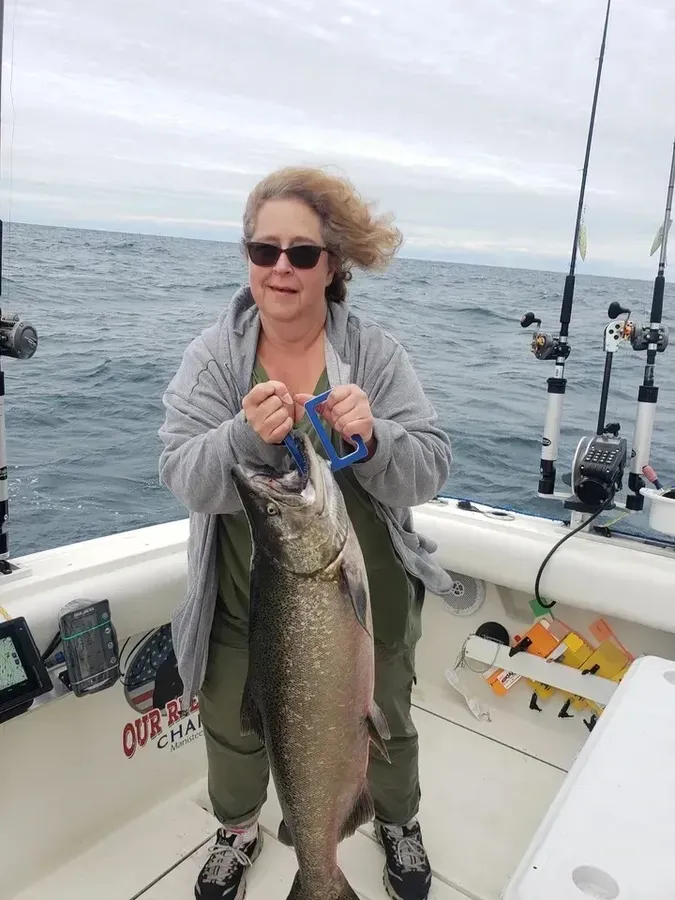
When current shifts, wind picks up, or you change direction, your trolling spread may start behaving differently.
Rather than changing several things at once, use the setup that was producing bites as your reference point. Check your speed, line angles, rod-tip movement, and downrigger cable position to identify what's changed.
If your lures are running shallower than expected, adjust your speed or downrigger settings.
If a diving lure is pulling too hard or losing its action, slow down and see how it responds. Planer boards and weighted lines may also need adjustments as current and drag change. Make these changes gradually and give your spread a little time to settle. Keeping track of the speed, direction, depth, and setup that produced bites will also help you recreate those conditions when you make another pass.
If you're fishing unfamiliar water or want to learn how local conditions affect trolling, book a trip with an experienced fishing guide through Guidesly and get hands-on advice to help you dial in your spread.